February 2026
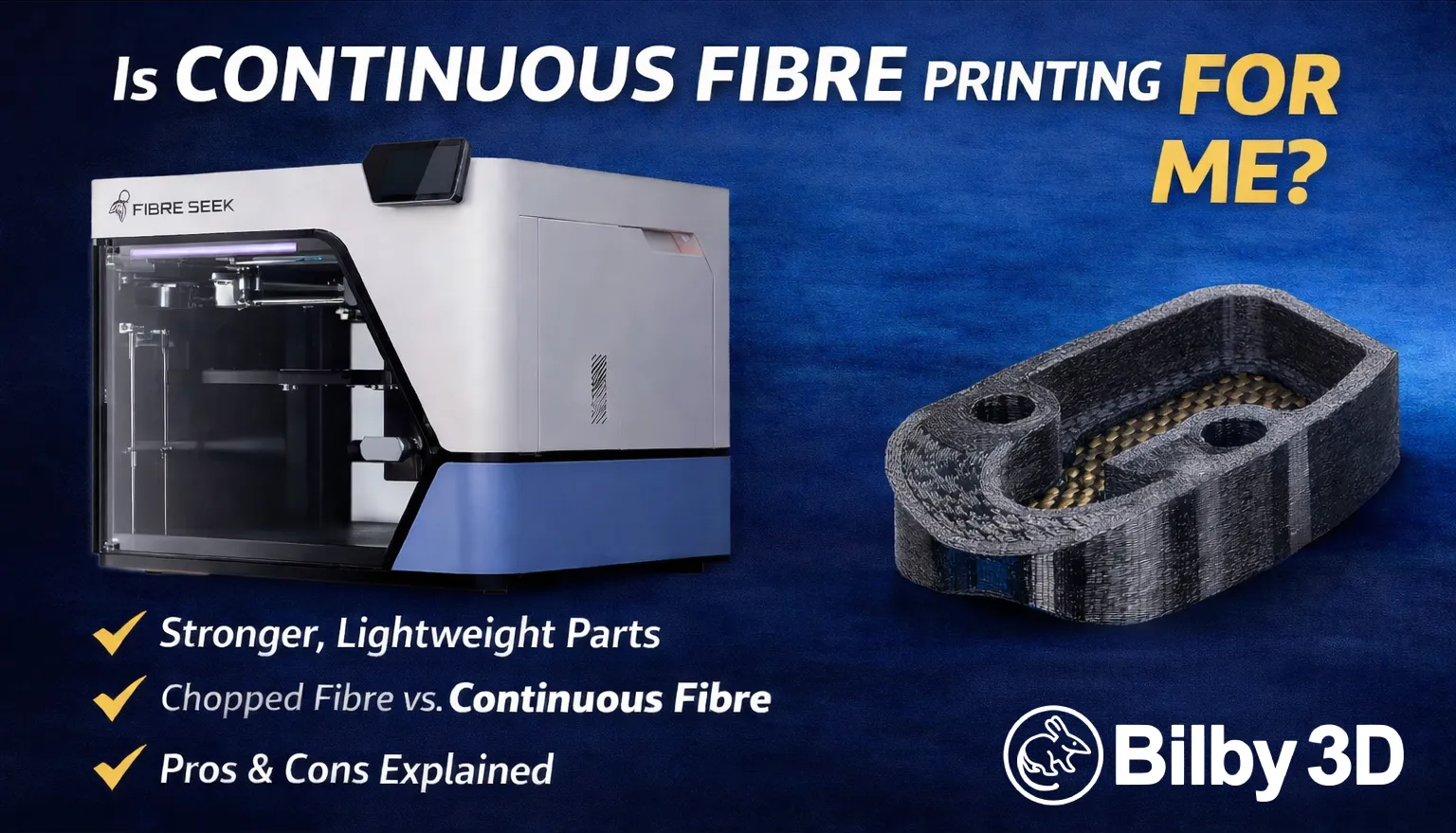
Is Continuous Fibre Printing for Me?
What SMBs need to know about continuous fibre reinforced 3D printing — pros, cons, real‑world expectations, and where the FibreSeeker3 fits.
Additive manufacturing has matured fast. For years, small and medium businesses have relied on chopped‑fibre filled filaments (e.g., carbon‑filled PLA/PA) and high‑performance thermoplastics
to push the limits of FDM/FFF printing. Now, continuous fibre composite (CFC) or continuous fibre reinforced 3D printing (CFRP) promises a step‑change in strength and stiffness — especially where weight, mechanical performance, and functional prototyping matter.
If you’re wondering “Is continuous fibre printing for me?”, this article will cut through the hype and ground you in what’s real, what’s useful, and where limitations still exist — with a clear look at the FibreSeeker3 from Bilby 3D.
What Is Continuous Fibre 3D Printing?
Traditional 3D printing with filled filaments mixes chopped fibres (short lengths of carbon, glass, or basalt) into a thermoplastic base. These short fibres typically align with the direction of nozzle travel, offering directional reinforcement. However, their short length limits how much load they can carry — strength gains plateau beyond a point.
Continuous fibre printing takes a different approach: it embeds long, aligned fibres (e.g., carbon, glass, basalt) directly into the print path where you choose, delivering much stronger reinforcement in key load paths — in essence, like placing rebar in a concrete beam.
The FibreSeeker3 uses a refined co‑extrusion system — based on Anisoprint technology — to embed fibre continuously through the thermoplastic matrix.
What Continuous Fibre Printing Is Good For?
- Functional, load‑bearing parts with high tensile strength and stiffness
- Lightweight components where you can orient fibres along major load directions
- Prototyping of ultimate parts before moving to composites tooling
- SMBs in robotics, jigs, automotive, aerospace, and OEM components
- Parts where traditional FDM/FFF materials fall short, but expensive metal solutions aren’t justified
Common CFC Issues Seen in Practice
- Limited Encapsulation of Fibre Bundles Fibre bundles must be fully wetted and surrounded by plastic to transfer loads effectively. In some geometries, fibres may not be completely encased, reducing effective strength or leaving exposed fibre ends.
- Fibre “Pull‑Through” in Tight Corners During sharp internal corners, fibre may straighten or “bridge” the angle, reducing reinforcement where you planned it. Slicer strategies help, but this remains geometry-dependent.
- CFC Feeding and Clogging Issues Co-extrusion systems are sensitive. Fibre snags, buckling, and inconsistent feeds can occur, especially during setup or if the material is improperly stored or loaded.
FibreSeeker3 vs. MarkForged: What's the Difference?
- Open Materials: FibreSeeker3 supports open filament and fibre options, unlike MarkForged’s closed ecosystem.
- Lower Price Point: FibreSeeker3 brings continuous fibre capabilities to SMBs at a more accessible cost.
- Improved Tuning & Flexibility: Co-extrusion quality is comparable, and the open system allows easier troubleshooting and innovation.
- Markforged’s Eiger slicer is free for cloud use, but offline use and advanced features require ongoing subscriptions.
- FibreSeeker’s slicer is free and works offline by default. A Pro version with extra features may come later, but core functionality doesn’t require a paid license.
Verdict: FibreSeeker3 is a smart alternative for those wanting performance, freedom, and local support — especially in Australia.
Chopped Fibre Filament vs. Continuous Fibre Printing
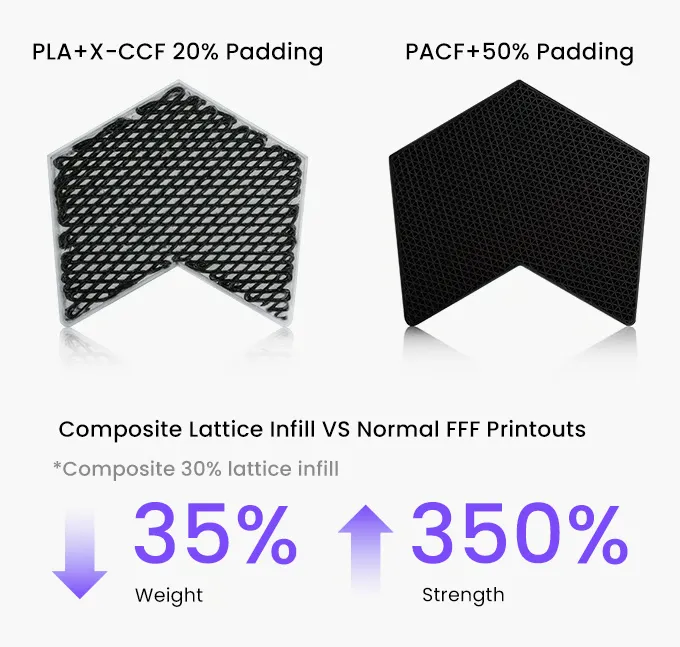
Chopped carbon or glass-filled filaments reinforce parts by aligning fibres with the nozzle’s path — offering meaningful stiffness gains. However, fibres are short and do not bridge layers well. Continuous fibre excels in longitudinal reinforcement but also faces limited Z-axis strength.
Z-Axis Strength and Adhesion
Layer adhesion remains the weakest point in FFF printing. Both fibre types face limitations here — except for standout materials like Polymaker Fiberon PA6-CF.
Note: Polymaker’s
Fiberon PA6-CF increases Z-axis tensile strength by
27% over non-reinforced PA6, using a fibre adhesion enhancer (per
ASTM D638 testing).
Surface Finish & Fibre Exposure
- Chopped-fibre filaments leave a rough, matte surface, which is attractive in some cases, but not suitable where smoothness of finish is important.
- Loose fibres can shed from surfaces, creating potential contamination or aesthetic concerns. It is rarely suitable for food, medical, or cleanroom use.
- Continuous fibre prints on the FibreSeeker3 deliver a smooth surface finish, consistent with the base plastic — fully encapsulated, clean, and more chemically resistant.
Best of Both Worlds
FibreSeeker3 allows printing with chopped-fibre model material (like PA-CF) while embedding continuous fibres for structural reinforcement. This hybrid approach enables:
- Improved isotropic base strength
- Directional fibre reinforcement where needed
- Cleaner surfaces with retained food safety or chemical resistance
Setting Realistic Expectations
Continuous fibre printing won't magically turn a basic print into a machined metal part — but it does offer a major leap in performance when used with the right base polymers and design strategies.
Used correctly, it delivers:
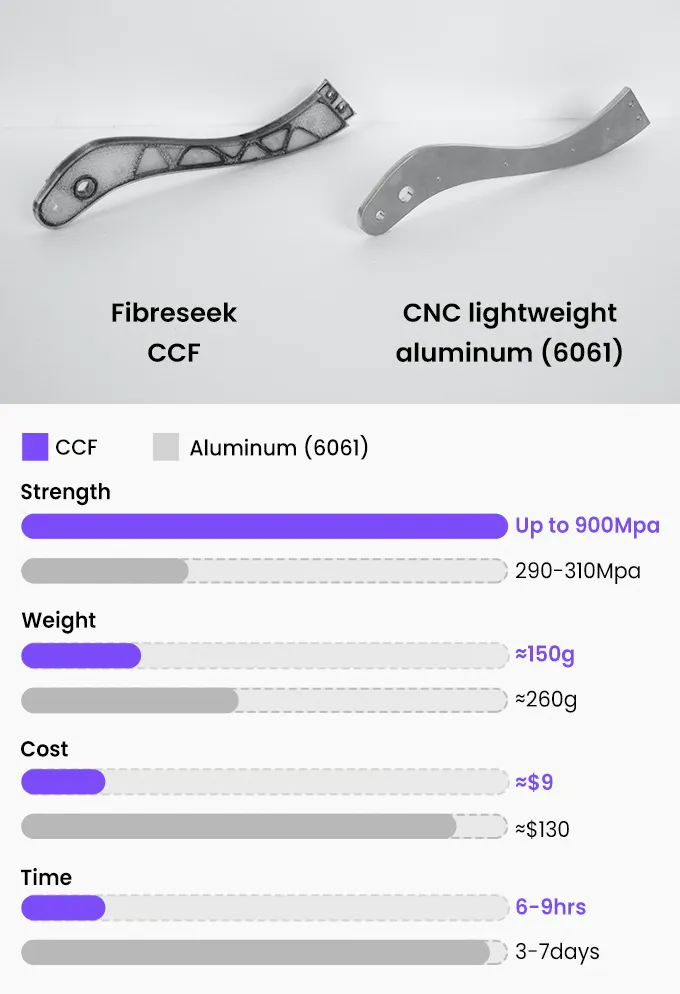
- Strength up to 5–10 times that of typical FFF prints (in primary load directions)
- Directional reinforcement with lower part mass
- Functional parts with reduced post-processing
But remember:
- Strength is anisotropic — plan your part orientation
- Sharp corners, fibre pathing, and slicing parameters directly affect fibre pathing and effectiveness
- Initial tuning and learning time is essential — especially for fibre feed rates, nozzle maintenance, and slicing strategies
Good news: You’re not limited to PLA.
FibreSeeker3 supports a broad range of open materials, including:
- PETG (included as standard)
- PA, PA-CF, PC, ABS
- Carbon Fibre and Fibreglass reinforcement filaments
This gives you flexibility to match base polymer properties with fibre reinforcement — combining chemical resistance, toughness, and heat performance with strategic structural strength.
Bottom Line — Who Is CFC Printing For?
YES:
- You design load-bearing, functional parts
- You want to replace machined metal or reduce weight
- You value open materials, and lower cost of ownership
MAYBE NOT:
- You prioritize speed and simplicity over mechanical performance
- You rarely print structural components
- You're fully satisfied with chopped-fibre filaments
Why FibreSeeker3 Makes Sense in Australia
With its Anisoprint-derived co-extrusion tech, open materials, and competitive pricing, the FibreSeeker3 is designed to bring high-strength composites into everyday use for SMBs.
Backed by Bilby 3D’s Australian service and support, it offers a powerful, flexible toolset for businesses ready to take the next step in additive manufacturing.
More FibreSeeker3
More Articles

 Sydney - Kingsgrove, NSW
 Melbourne - Clayton, VIC