
 Sydney - Kingsgrove, NSW
 Melbourne - Clayton, VIC
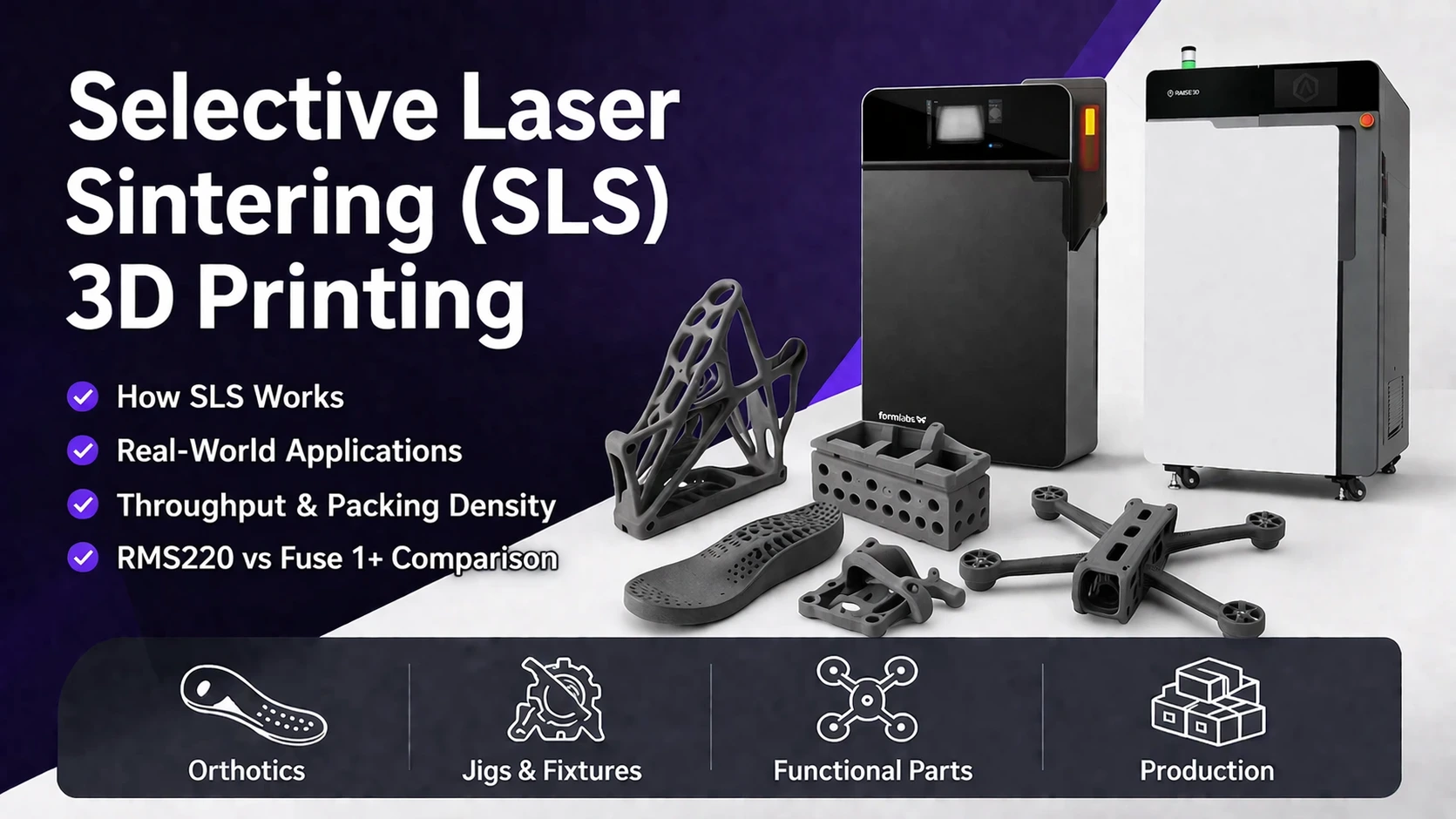
Selective Laser Sintering (SLS) is a mature additive manufacturing process used to produce strong, functional thermoplastic parts without the need for support structures. For Australian engineering and design teams, it offers a practical pathway from prototyping into low-volume production, with a strong balance of mechanical performance, repeatability, and design freedom.
However, evaluating SLS systems requires more than comparing specifications. Real-world performance is driven by throughput, packing density, workflow, cooling time, and total system footprint. This article explains how SLS works in practice, where it is used, what to consider before investing, and where the Raise3D RMS220 sits in the current market.
Precise control of the melt zone is critical in SLS. If the laser input is not well controlled, issues such as porosity, warping, and dimensional inaccuracy can occur. When tuned correctly, the process produces strong, repeatable parts suitable for engineering use.
Each layer is applied using a "re-coater", a roller or blade to spread powder across the build surface. This introduces a mechanical variable into the process — the powder cake is not perfectly rigid, and shifting or disturbance can occur, particularly with tall or delicate geometries. While often promoted as not requiring support structures, this is only partially true. The surrounding powder supports the part, but certain geometries can still be problematic. Large cross-sectional changes that can't be avoided by re-orientation, shrinkage effects, and interaction with the powder spreading mechanism can introduce distortion if not managed through part orientation and process control. When layers of parts are packed on top of each other, supports are often added to space them vertically, again avoiding part movement within the cake, or fusing together
Once printing is complete, the entire powder cake must cool gradually. This is a critical phase of the process, and in many systems, it represents a significant portion of total production time. 50% of the print time is often quoted, so a 24 hour print job will need to cool for 12 hours. Some machines will not allow the build unit to be removed so the machine can be restarted during cooling.

Packing density is one of the most important factors in SLS production. It describes how much of the available build volume is occupied by parts as a percentage. 30% is often the target, as it matches 70% powder re-use, the highest material re-use proportion (under a protective gas). Manufacturers' software can automatically pack parts, though doing so by hand can result in higher packing density (with better part orientation) if the labour cost is warranted. Third party software such as Materialise Magics is also available for mesh repair, packing and support generation.
Because SLS does not (generally) require support structures, parts can be tightly nested and stacked within a build. In theory, this allows very high utilisation of the build volume. In practice, however, results vary significantly.
Many users report that real-world packing densities fall well short of theoretical claims. This is influenced by part geometry, thermal considerations, spacing requirements, and the limitations of nesting software. Ask your sales rep for actual nesting figures and print times using your models, if the software is not accessible before purchase.
For Engineering Teams, packing density directly affects:
It is important to understand that throughput is not defined by print speed alone. A larger build volume, better cooling workflow, or more effective nesting can result in significantly higher output even if raw print times appear similar.

SLS is most commonly used with nylon-based powders such as PA12 and PA11, which provide strong, durable parts suitable for functional applications. TPU is increasingly used for flexible components, and reinforced powders such as carbon fibre-filled materials are becoming more widely available.
Part accuracy and surface finish are influenced by the powder particle size (typically around 30 microns), as well as laser control and thermal management. While SLS does not achieve the surface finish of SLA, it produces parts that are far more suitable for structural and functional use.
Once parts are removed from the powder cake, the remaining unfused powder is typically recovered and reused. This is done by passing the powder through a vibrating sieve to remove fragments and contaminants before mixing it with fresh powder.
Because the entire powder bed is heated during each build, the material gradually degrades over time. Recycle rates of up to 70% are common, with the remaining percentage made up of fresh powder.
The use of an inert atmosphere (typically nitrogen) can reduce oxidation and improve material longevity. Without this, higher refresh rates are required, which can increase material costs. Whether you use bottled gas, or a nitrogen generator (the Raise3D RMS220 has one built in to extract Nitrogen from Compressed Air), the floorspace required should also be a factor in decision making
Most SLS workflows include powder management systems that combine sieving and mixing. These may be integrated into cleaning stations or provided as separate units, and should be considered when evaluating a system.
Multi Jet Fusion (MJF), commercialised by HP, uses a powder bed but replaces the laser with inkjet-applied fusing agents and infrared heating. It is claimed to be faster and can produce improved surface finish, but is limited to proprietary materials and consumables. A proper cost-per-part analysis is required for meaningful comparison.
FDM offers low-cost machines and materials, along with a wide material range. However, parts are anisotropic and often require supports. Specialised support materials can reduce the considerable removal time, but are more expensive than the model material itself. SLS provides stronger, more consistent parts and can outperform FDM in production scenarios where labour, finish, and repeatability are critical.
SLA provides excellent surface detail and finish, but is generally less suitable for functional engineering parts. Materials can become brittle over time, and costs are higher. SLS is better suited to durable, load-bearing applications.
SLS is widely used across Australian industries for both prototyping and production.
One of the most established applications is orthotics, where nylon and TPU are used to produce custom insoles and braces in large volumes with high repeatability and accuracy.
We also have customers using SLS for producing small functional components, including brackets, jigs, and fixtures, as well as more advanced applications such as drone bodies.
These applications highlight where SLS delivers real value — strong, complex parts produced efficiently without tooling.
SLS systems involve fine polymer powders, elevated temperatures, and in some cases inert gas environments. While these systems are designed for safe operation, there are several practical safety considerations that should be understood before installation.
Airborne Powder and Inhalation Risk:
SLS powders are very fine and can become airborne during handling, de-caking, and sieving. Inhalation of fine particulates should be avoided.
Appropriate PPE such as dust masks or respirators, along with good housekeeping and cleaning practices, are recommended, even when using a cleaning unit with powerful suction and filtering.
Many workflows also include anti-static vacuums designed for powder handling.
Dust Explosion Risk
Like many fine powders, SLS materials can present a dust explosion risk under the right conditions — typically requiring a confined space, airborne particles, and an ignition source.
While this risk is generally low in well-managed environments, it reinforces the need for proper equipment, grounding (anti-static control), and avoidance of ignition sources during powder handling.
Nitrogen and Oxygen Displacement
Some SLS systems use nitrogen to create an inert atmosphere, which improves material stability and reduces oxidation. However, nitrogen can displace oxygen in enclosed spaces.
If nitrogen is supplied from cylinders or generated on-site, consideration should be given to room ventilation and the potential need for an oxygen monitor, particularly in smaller or enclosed rooms.
In systems with integrated nitrogen generation, such as those using compressed air separation, the majority of displaced gases are typically returned to the environment. However, room size, ventilation, and system duty cycle should still be assessed to ensure safe oxygen levels are maintained.
Fume Extraction and Ventilation
SLS does not typically produce the same level of fumes as processes such as FDM or SLA, as the material is sintered rather than fully melted or chemically cured.
However, elevated temperatures and material processing can still generate odours or low levels of emissions. General room ventilation is usually sufficient,
though some installations may benefit from local extraction depending on usage and environment.
As with any industrial equipment, safety requirements should be assessed as part of installation planning, taking into account room size, usage patterns, and applicable workplace safety standards.
The Raise3D RMS220 sits between entry-level SLS systems and full industrial platforms.
It offers significantly higher build capacity and reduced downtime, without the footprint and cost of larger industrial machines.
For businesses focused on production rather than prototyping, this combination of build size, cooling efficiency, and workflow design can result in substantially higher output.

| Model | Build Size (mm) | Laser Power | Reccomended Footprint (mm) | Application |
|---|---|---|---|---|
| SinterIT Lisa X | 130 x 180 x 330 | 30W IR Fibre | (Machine) 650 x 610 x 1200 | Occasional use. Experimental, prototypes and small batch production |
| FormLabs Fuse1+ | 165 x 165 x 300 | 30W Ytterbium Fibre | 1455 x 1495 x 1675 | Frequent prototypes, small batch production |
| Raise3D RMS220 | 220 x 220 x 350 | 75W IR Fibre | (Machine) 861 x 685 x 1558 | Small batch to 24/7 production |
| EOS Formiga P 110 Velocis | 200 x 250 x 330 | 30W CO2 | 3200 x 3500 x 3000 | 24/7/365 Production |
| Factor | Formlabs Fuse 1+ 30W | Raise3D RMS220 |
|---|---|---|
| Laser Power | 30 W | 75 W |
| Build Volume | 8.2 L | 16.9 L (2× larger) |
| Usable Size | 165 x 165 x 300 mm | 220 x 220 x 350 mm |
| Printer Size | 645 × 685 × 1065 mm | 861 x 685 x 1560 mm |
| Cooling Workflow | 50% of print time (eg: 24hr print, 12hours cooling). Build units can be unplugged, lifted out and replaced once cooled. | As little as half an hour with active cooling switched on. Cable-less build units can be wheeled out and plugged into the cleaning station, or a wall outlet for active cooling. |
| Inert Gas Use (if used) | Nitrogen Gas: 14Lt/min at 36-125 psi | Inbuilt Nitrogen Generator: Requires compressed air, 360Ltmin @ 87-116 psi, or gas line |
| Material change- over time | 1-4 hours depending on which materials. 1 hour for the machine. 4 for machine + sift | 45 minutes, machine only. All parts accessible through hatches. Sift times not stated. |
Material developments continue to expand the capabilities of SLS. Powders incorporating chopped-strand carbon and glass fibres are already available, and Kevlar is likely as demand rises.
Raise3D is working with European partners on
thermoplastic-bound metal powder systems, called CFM - Cold Metal Fusion,
enabling printed parts to be debound and sintered into fully metal components.
This has the potential to significantly broaden the applications of systems like the RMS220, particularly as these technologies become available in Australia.
SLS is a powerful manufacturing technology, with lots of potential for serial production. Real-world performance depends on more than specifications. Build size, packing density, cooling time, and workflow all contribute to actual output.
The Raise3D RMS220 addresses several of the key bottlenecks in SLS production, making it particularly well suited to businesses aiming to maximise parts per week rather than simply produce prototypes.
Founder, Bilby3D
Chris Bilby founded Bilby3D in 2011 and has spent more than 15 years helping Australian businesses, schools, universities and manufacturers adopt additive manufacturing technologies. With an engineering background and extensive hands-on experience, he has personally installed, configured, serviced and trained customers on hundreds of professional 3D printers and 3D scanners.
Under Chris's leadership, Bilby3D has supplied thousands of additive manufacturing systems across Australia. Chris has completed manufacturer training in Germany, England, China and Thailand, and regularly evaluates emerging 3D printing technologies, materials and workflows to provide practical, experience-based advice.
Connect with Chris on LinkedIn.

Nitrogen plays an important role in SLS 3D printing by reducing powder exposure to oxygen inside the build chamber. This helps limit powder oxidation and degradation, allowing more unsintered powder to be reused while maintaining better material consistency across production runs. This article explains why an inert build environment matters, how it supports Nylon PA11 and PA12 powder refresh rates, and what it means for part quality and operating cost.


