
 Sydney - Kingsgrove, NSW
 Melbourne - Clayton, VIC

Selective Laser Sintering (SLS) is widely used for strong, functional thermoplastic parts, especially with materials such as PA12, PA11 and TPU. While laser power, layer height and material choice are often discussed, one of the most important process variables is less visible: the atmosphere inside the build chamber.
During SLS printing, the powder bed is held at an elevated temperature for many hours. It is held near the melting point, so the laser has to provide less heat, and so can move more quickly. Dwelling for longer leads to increased heat spread (a larger heat/melt pool), so surface detail and finish will be lost. If oxygen is present, hot polymer powder can oxidise, changing how it melts, flows and fuses. This can reduce mechanical consistency, shorten powder life and increase the cost per part.
Nitrogen is used to displace oxygen in the build chamber. A stable low-oxygen environment helps reduce thermo-oxidative ageing, improving part consistency and powder reuse.
Oxygen exposure affects SLS parts by ageing the powder before it is even printed. Reused powder typically shows reduced flowability, increased viscosity and less predictable fusion behaviour. A 2024 study on PA12 powder reuse found that, over seven build cycles using a 70:30 used-to-virgin refresh ratio, melting temperature increased by 4.5°C, powder flowability dropped by 20%, part porosity increased by 5.8%, and Ultimate Tensile Strength (UTS) fell by 11%. Source
This is why UTS alone does not tell the full story. Parts may still look strong on a datasheet while becoming more brittle, less ductile or less repeatable across builds.
| Material | Typical SLS Use | Atmosphere Sensitivity | Nitrogen Consideration |
|---|---|---|---|
| PA12 | General engineering parts, housings, fixtures, prototypes | Moderate | Generally forgiving; onboard nitrogen generation is often sufficient. |
| PA11 | Ductile, impact-resistant and functional end-use parts | High | More prone to oxidation; external nitrogen is recommended for maximum reuse, UTS consistency and surface quality. |
| TPU | Flexible parts, grips, seals, cushioning, wear-resistant components | Material-dependent | Can be often processed without nitrogen. A stable atmosphere helps maintain consistency, but TPU reuse behaviour depends strongly on the specific powder formulation. |
PA12 is the most forgiving SLS thermoplastic and is often the easiest material to reuse reliably. PA11 offers excellent toughness and ductility, but is more sensitive to oxidation and thermal history. TPU adds rubber-like flexible parts to SLS production, many powders can be used without shielding gases, but because TPU powders vary widely by chemistry and hardness, reuse rates and nitrogen requirements should be checked against the specific material's datasheet.
Nitrogen purity is important, but so is supply capacity. At the start of a print, the entire build chamber must be flushed to remove oxygen. This purge stage requires high gas flow. Bottled nitrogen or a large nitrogen generator with a buffer tank can maintain both flow and purity during this peak demand.
Small onboard nitrogen generators may be adequate during steady printing, but can experience a drop in purity during chamber purging. This is especially important for PA11, where Raise3D recommends external nitrogen when targeting maximum powder reuse, highest UTS consistency and reduced orange peel.
Raise3D has advised that its published powder TDS values are based on 100% virgin powder using the onboard nitrogen generator. For PA12 and PAnext, this onboard system is generally sufficient. For PA11, an external nitrogen supply is recommended when the priority is maximum reuse rate, best surface finish and the most consistent mechanical performance.
This is not a limitation unique to the RMS220. It is a practical reality of polymer SLS: different thermoplastics respond differently to oxygen, heat and reuse.
In SLS 3D printing, nitrogen is not just a background process gas. It directly affects part strength, surface finish, powder reuse and total cost of ownership. For PA12, onboard nitrogen generation is often enough. For PA11, a higher-capacity nitrogen supply can make a measurable difference. For TPU, results depend on the formulation, so material-specific testing and datasheet guidance are essential.
For production users, the takeaway is simple: atmosphere control is part of the material system. Better nitrogen control means better repeatability, better powder economics and more reliable SLS manufacturing.
Founder, Bilby3D
Chris Bilby founded Bilby3D in 2011 and has spent more than 15 years helping Australian businesses, schools, universities and manufacturers adopt additive manufacturing technologies. With an engineering background and extensive hands-on experience, he has personally installed, configured, serviced and trained customers on hundreds of professional 3D printers and 3D scanners.
Under Chris's leadership, Bilby3D has supplied thousands of additive manufacturing systems across Australia. Chris has completed manufacturer training in Germany, England, China and Thailand, and regularly evaluates emerging 3D printing technologies, materials and workflows to provide practical, experience-based advice.
Connect with Chris on LinkedIn.
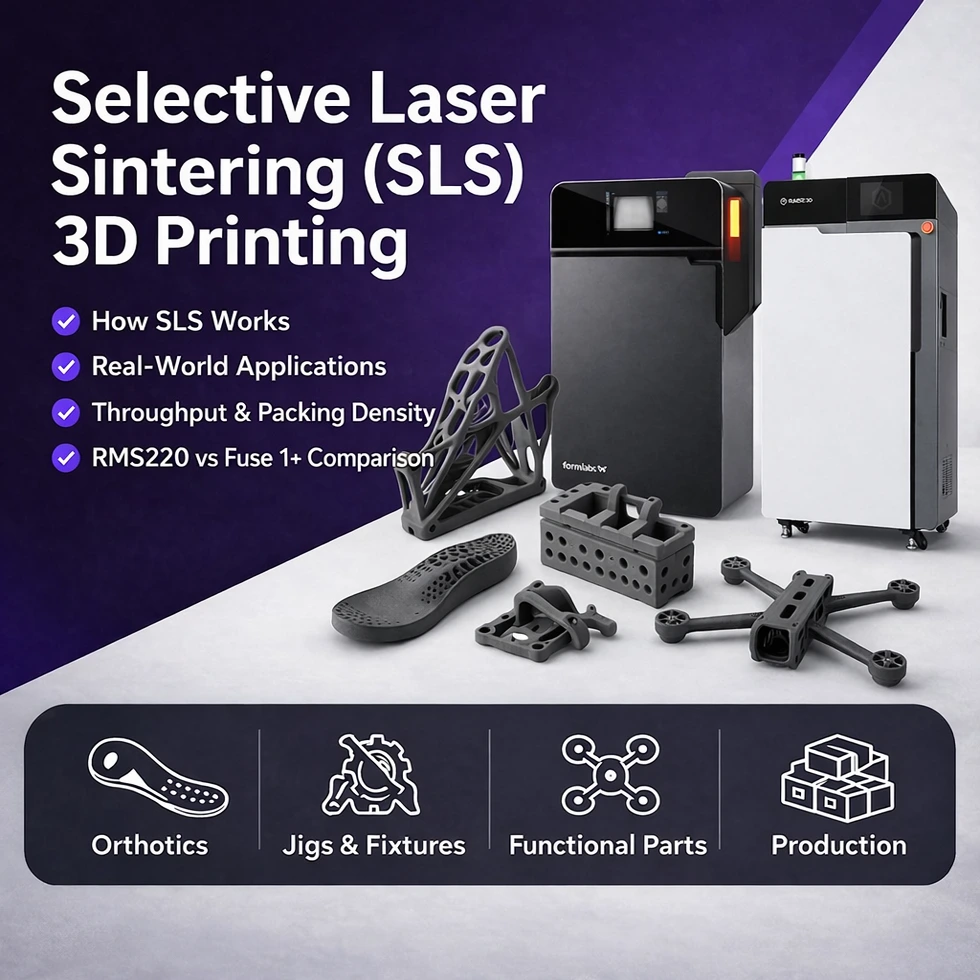
A real-world look at SLS 3D printing, focusing on throughput, packing density and production workflows. Includes applications across orthotics, manufacturing and product design, plus RMS220 vs Fuse 1+ comparison.


