
 Sydney - Kingsgrove, NSW
 Melbourne - Clayton, VIC

By Bilby
In additive manufacturing (AM), precision isn’t a luxury — it’s a requirement. Whether creating functional prototypes, production parts, or mission‑critical components, tolerances define the bridge between digital geometry and physical reality. Yet compared with traditional manufacturing, tolerancing in AM brings unique opportunities and challenges rooted in material behaviour, process physics, and design strategy.
This article explores what tolerances are, how they differ between AM plastic technologies, what factors influence them, and how engineers can optimise designs to meet performance requirements.
A tolerance is an allowable limit of variation from a nominal dimension — the “wiggle room” designers permit so parts still function if they’re not perfect. In engineering terms, tolerances underpin fit, form, and function.
In AM, tolerances differ from traditional methods because parts are built in layers, introducing variation from thermal effects, material shrinkage, and resolution limits.
In AM, the way material is deposited or cured layer by layer introduces unique variations not found in subtractive or moulding processes. Understanding these variations helps in designing parts that account for real-world outcomes, not just CAD intent.
AM tolerances are usually expressed as a fixed value plus a percentage of the feature size, e.g., ±0.1 mm + 0.2 % of the nominal dimension.
Tolerances vary by technology, material, and machine calibration. Here are typical benchmarks:
| AM Technology | Estimated Tolerance | Notes |
|---|---|---|
| SLA / DLP / LCD | ±0.1 to ±0.3 mm | High resolution, susceptible to resin shrinkage |
| SLS / MJF (Nylon) | ±0.2 to ±0.3 mm (or ±0.3%) | Good for complex, unsupported geometries |
| FDM / FFF | ±0.5 mm standard; ±0.2 mm on precision machines | Influenced by extrusion and cooling |
| FGF / Pellet | ±0.5 to ±1.0 mm | Large scale processes with coarse resolution |
These values serve as guidelines. The tighter the tolerance, the greater the need for calibration, environmental control, and sometimes post-processing like machining or annealing.
Example: In the Bilby3D Print Service, when using PLA on a Raise3D Pro3HS, we will start with a 0.5mm tolerance, then reduce to as little as 0.2mm for a repeatable push-fit of metal parts.
Dimensional tolerance alone does not capture issues like warping, bowing, or distortion. These geometric inaccuracies are common in larger parts, parts with thin walls, or features with broad flat spans. Causes include:
These issues may not appear in simple dimensional measurements but can compromise flatness, roundness, or parallelism, making them critical for mating parts or assemblies requiring precision alignment.
Surface finish affects more than appearance—it can impact functional tolerances:
For close-fitting parts, designers should compensate for surface roughness. For example, a 0.2 mm clearance in CAD may be inadequate if surface peaks exceed 0.1 mm. Testing and measurement of as-printed parts are essential.
Parts rarely remain static after printing. Some changes are deliberate, like annealing; others are environmental, like water absorption. Both affect final dimensions.
Thermal annealing improves strength and crystallinity in semi-crystalline materials like PLA, PETG, and PA. However, it often causes:
Designers should anticipate this by printing test coupons and adjusting dimensions accordingly. Alternatively, critical features can be post-machined after annealing.
Nylon is hygroscopic: it absorbs water from the atmosphere, which causes it to expand slightly and soften. In humid environments:
For best dimensional stability, dry PA parts before assembly or ensure parts are acclimatised in their end-use environment. Sealed storage is essential for tight-tolerance nylon parts.
Design for manufacturing is critical. To manage tolerance-related risks:
Always test tolerances on your specific printer and material combination — manufacturer specs are good starting points, not guarantees.
| Process | Typical Tolerance | Consistency | Setup Time | Notes |
|---|---|---|---|---|
| CNC Machining | ±0.01 – ±0.05 mm | Very High | Moderate | Best for tight tolerances and hard materials |
| Injection Moulding | ±0.05 – ±0.1 mm | Excellent | High (tooling) | High repeatability; expensive for small runs |
| Additive Manufacturing | ±0.1 – ±0.5 mm | Good with calibration | Low | Ideal for complex geometries, faster iteration |
While traditional methods like injection moulding and CNC machining offer tighter tolerances, they require longer lead times, expensive tooling, or subtractive workflows. Additive Manufacturing gives much more design flexability, near zero cost of complexity, as well as offering faster iteration and digital flexibility. It requires design awareness to accommodate looser tolerances and part variability.
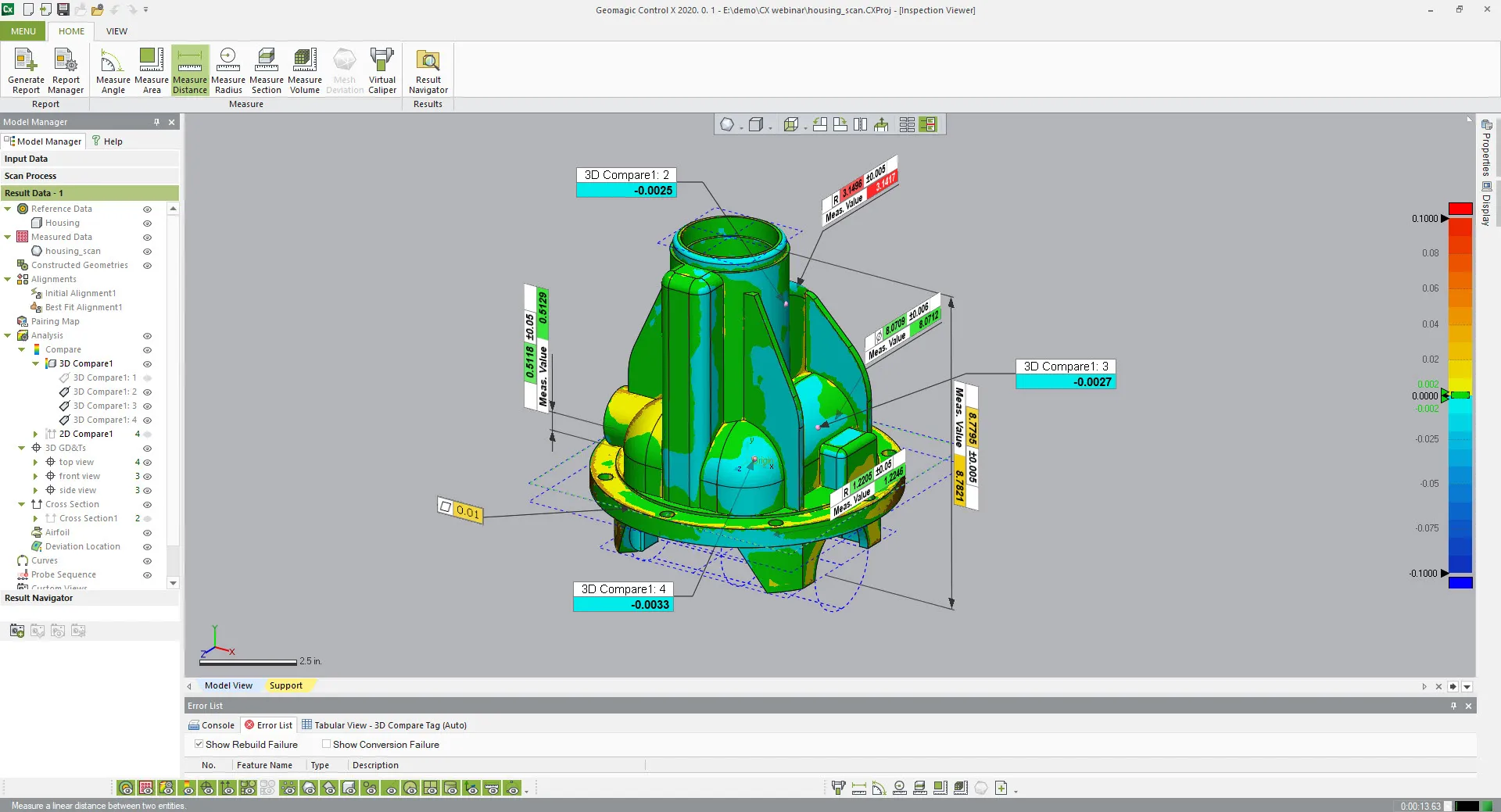
Validating tolerances is essential in any precision-focused Additive Manufacturing workflow—especially when parts are destined for functional assemblies, repeated builds, or regulated industries. Visual inspection alone is insufficient; only comparison against the original CAD model confirms whether a part meets dimensional and geometric specifications.
Measurement tools such as coordinate measuring machines (CMMs), metrology-grade optical scanners, and tolerance test benchmarks enable this verification. These methods assess both feature-level accuracy and process repeatability, which becomes critical as tolerances tighten and minor deviations can affect performance or fit.
Modern inspection software, such as Shining3D Inspect and Control X, streamlines this workflow and removes the human element. Engineers can import CAD models, define GD&T criteria (flatness, parallelism, hole position, roundness, etc.), overlay scan data, and generate clear, colour-mapped reports. These reports—exportable as PDFs or CSVs. They quantify deviation, enabling both real-time feedback and certifiable documentation.
For sectors like aerospace and defence, this level of metrology is a requirement, supporting traceability, compliance, and confidence that AM parts meet stringent engineering standards.
While validating a single part is important, ensuring consistent quality across multiple completed parts is essential for production. Statistical Process Control (SPC) enables manufacturers to monitor and refine the repeatability of additive processes over time.
SPC uses dimensional data from multiple builds—such as hole diameters or flatness deviations—to detect trends or variability. By applying control limits based on standard deviation from the mean, it becomes possible to distinguish random variation from systemic issues like machine drift, orientation-dependent distortion, or environmental changes.
When integrated with inspection workflows, SPC helps identify root causes of inconsistency and triggers recalibration or process adjustments before defects escalate. For high-reliability applications, it reinforces the transition of AM from prototyping to trusted production—ensuring not just accuracy, but reliable reproducibility.
Unlike conventional manufacturing processes such as CNC machining or injection moulding, additive manufacturing is still a relatively young industrial technology. As a result, its standards ecosystem—particularly around tolerances, dimensional accuracy, and process capability—is still evolving. While traditional manufacturing benefits from decades of established ISO and ASME tolerance frameworks, additive manufacturing standards are only now reaching a level of maturity suitable for production use.
International standards bodies such as ISO and ASTM have been working collaboratively to address this gap through the ISO/ASTM 52900 series of additive manufacturing standards. These documents aim to create a common language for AM processes, materials, test methods, and quality assurance, including how dimensional accuracy and tolerances should be specified, measured, and reported.
Rather than prescribing universal tolerance values, most additive manufacturing standards focus on how tolerances should be defined and validated. This reflects the reality that AM tolerances are highly dependent on process type, material, machine configuration, build orientation, and post-processing. In practice, this means standards encourage manufacturers to qualify their own processes and document achievable tolerances, rather than relying on generic assumptions.
For engineers and designers, this places greater responsibility on clear communication. Where possible, tolerances should be explicitly stated on drawings or digital models, using established GD&T principles for dimensional and geometric control.
In addition to nominal dimensions, it is increasingly common to specify:
In regulated industries such as aerospace, defence, and medical devices, alignment with recognised standards is often mandatory. Even where formal certification is not required, referencing ISO/ASTM frameworks provides confidence to customers and stakeholders that additive manufacturing processes are being controlled, measured, and documented in a repeatable and auditable way.
Comparison of Tolerance Standards: Additive vs Traditional Manufacturing
| Standard / Framework | Applies To | Scope | AM Equivalent or Relevance |
|---|---|---|---|
| ISO 2768‑1 / ISO 2768‑2 | General Machining | General dimensional and geometric tolerances for parts without individual tolerance specifications | Not directly applicable to AM; can be referenced for post-machined features or hybrid workflows |
| ASME Y14.5 | Geometric Dimensioning and Tolerancing (GD&T) | System for defining form, orientation, profile, runout, and position tolerances | Applicable to AM; supports clear communication of functional tolerances in digital drawings |
| ISO/ASTM 52900 | Additive Manufacturing – General Principles | Terminology and high-level framework for AM processes | Foundational reference for AM terminology; basis for more specific tolerance-related documents |
| ISO/ASTM 52902 | Material Extrusion AM | Test artefacts and methods for validating dimensional accuracy and tolerances | Useful for establishing printer baselines and verifying part accuracy per material and orientation |
| ISO/ASTM 52921 | AM File Format & CAD Prep | Defines tolerancing concepts, part orientation, and support structures for AM-specific design | Helps bridge between CAD and AM-specific print requirements |
| ISO 8062‑3 | Castings | Dimensional tolerances for as-cast surfaces and features | Conceptually similar to “as-printed” tolerances in AM; sometimes used as a proxy for AM tolerancing |
Additive manufacturing empowers designers with complexity and customisation — but achieving precision takes strategy. By understanding process behaviours, aligning expectations, and designing for the real-world output of your chosen technology, you can ensure your 3D printed parts deliver both in form and function.
Have a specific application or part in mind? Bilby 3D’s technical team can help you dial in tolerances, material choices, and printer settings for your project — from prototype to production.


