


 Sydney - Kingsgrove, NSW
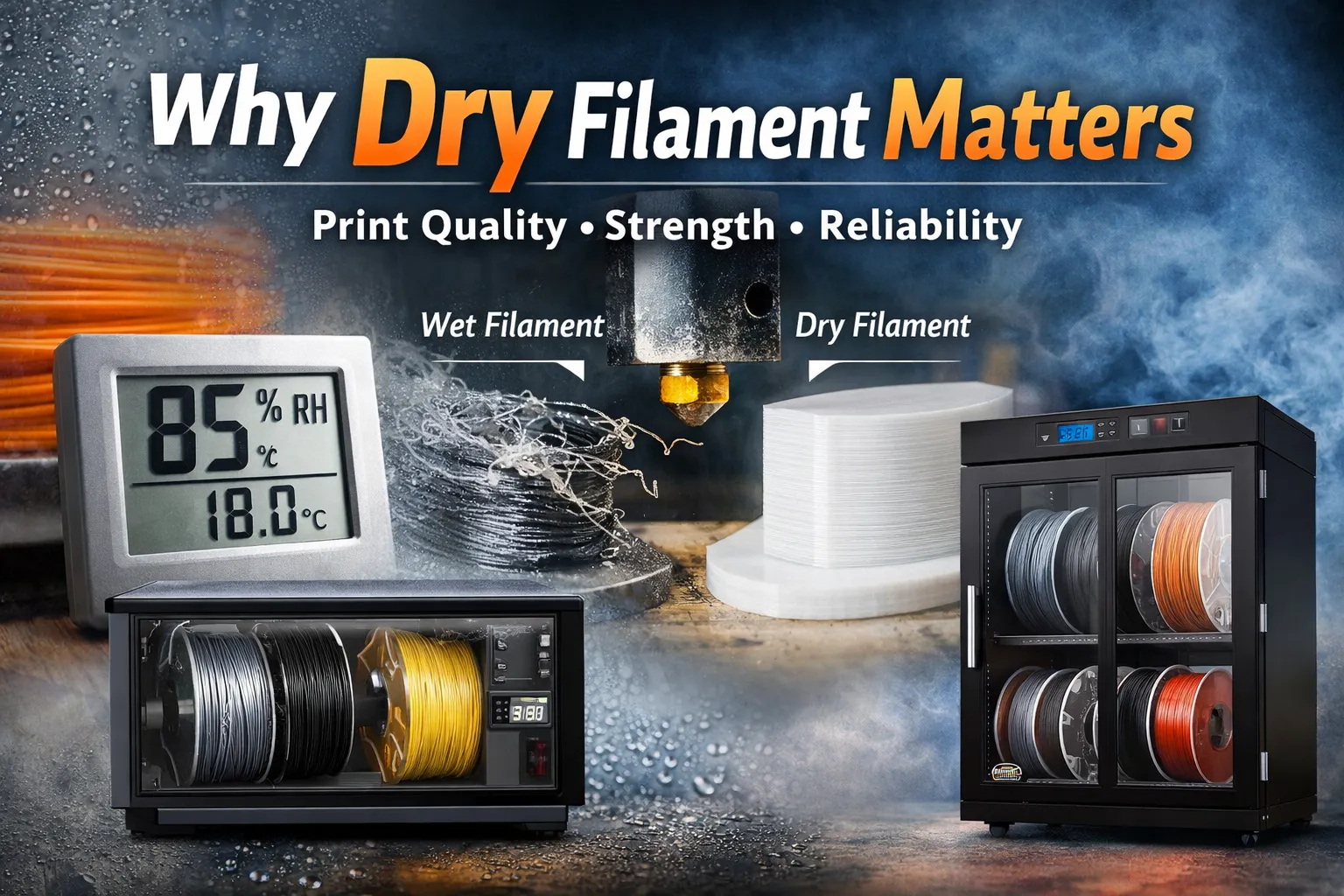
Why Dry Filament Matters: The Hidden Key to Print Quality, Strength & Reliability
by Bilby3D
Whether you're printing classroom prototypes, end-use parts, or engineering samples, moisture in filament is one of the most common—and most misunderstood—causes of print failures. From surface quality to part strength and dimensional accuracy, keeping your filament dry is critical to achieving consistent results.
Anyone who’s worked with plastic injection moulding or pellet extrusion knows one truth: drying your material is non-negotiable. Moisture in thermoplastics causes bubbling, poor surface finish, and degraded mechanical properties. The same rules apply to 3D printing — whether you're using filament or feeding pellets into a large-format printer like the Mingda MEXTRU, which features onboard pellet hopper drying for exactly this reason.
Yet too often, filament is left exposed on printers, in open bins, or inside heated boxes that don’t actually remove water. Let’s break down what’s happening, why it matters, and how to fix it—properly.
Why Filament Needs to Stay Dry
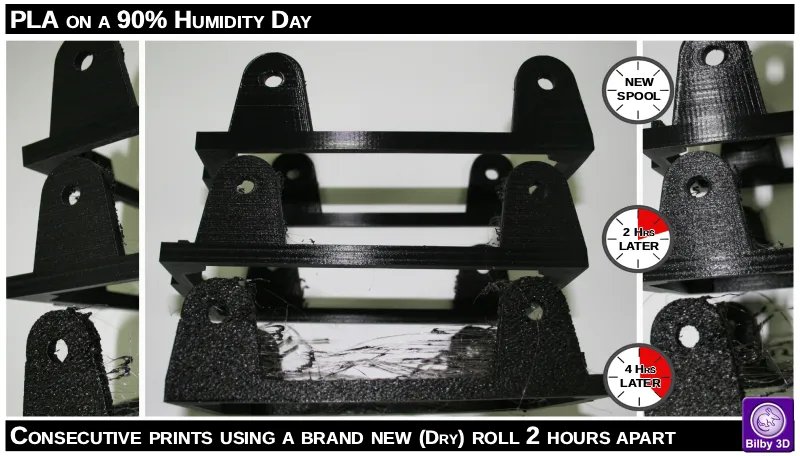
Most 3D printing filaments are hygroscopic—meaning they absorb water from the air. Once absorbed, this moisture doesn’t just sit on the surface. It works its way between and into polymer chains, especially in materials like Nylon (PA).
- Water turns to steam, forming bubbles and vapour during printing
- Results in stringing, popping, surface fuzz, and under-extrusion
- Layer adhesion weakens, making parts brittle or inconsistent
- Steam bubbles form voids within the print, reducing strength and allowing containmant ingress
- Don't assume filament is dry straight from the package. Use a tested and standardised drying and storage regime for reliable, repeatable printing
Dry filament = clean, strong, and predictable prints.
Wet filament = unreliable and wasteful.

Understanding Relative Humidity (RH)
Relative Humidity (RH) is the percentage of moisture in the air compared to the maximum it can hold at that temperature. It is not an absolute measure of how much water is in the air.
For example, air at 50% RH at 30°C would read around 85–90% RH at 18°C — even though no extra moisture was added. The filament, however, would absorb water faster at the higher RH.
This is why simply heating filament in a sealed box isn't enough — the moisture hasn’t gone anywhere. Once the air cools again, it will be reabsorbed by the filament unless it’s been physically removed or vented.
Nylon (PA) Water Absorption
With PLA, PET and TPU, water molecules sit loosely between the carbon chains.
PA (Nylon) forms polar hydrogen bonds between water molecules and its polymer chains, making it absorb moisture faster and dry slower. Heat is needed to provide the energy to break the polar bonds, and a vacuum is best to remove the water from the cabinet, but vacuum ovens are impractically expensive for most requirements.
Not all nylons are the same. PA6 (Nylon 6) offers higher tensile strength and toughness, making it ideal for mechanically loaded parts. However, it's also more hygroscopic than PA12, meaning it absorbs moisture faster and to a greater degree. PA12, while slightly weaker, is more dimensionally stable in humid environments and often preferred where printability, water resistance or long-term stability is more critical than peak strength. The proerties of all PA also change post-printing as their moisture content equalises with the environment.
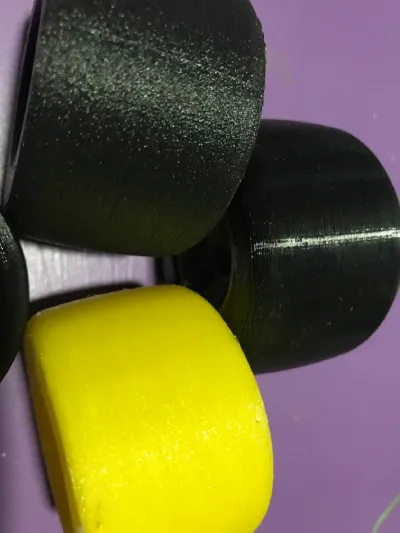 TPU prints are shinny when dry (right), but dull when wet (left black and yellow)
Which Filaments Absorb Water Most?
This table gives rough numbers on how hygroscopic different materials are, always check the manufacturers TDS for their formulation and drying recommendations.| Filament | Water Absorption | Ideal RH% for Storage | Notes |
|---|---|---|---|
| Nylon (PA) | Very High | <10% | Absorbs moisture rapidly and deeply |
| TPU / TPE | High | <15% | Loses elasticity and flow control when wet |
| PETG | Moderate | <20% | Bubbles and strings when damp |
| PLA | Moderate | <30% | Can become brittle; softens and strings |
| ABS / ASA | Low | <50% | Less sensitive, but still affected over time |
| PC / Polycarbonate | High | <10% | Prone to cracking and warping if wet |
Over-Drying and Heat Damage
- PLA becomes brittle if stored in ultra-low humidity too long
- TPU, PVA and other materials degrade if overheated
- Thermal material degradation from repeated heating affects printability and properties
Best practice: Use passive or RH-controlled systems for storage, not just heat.
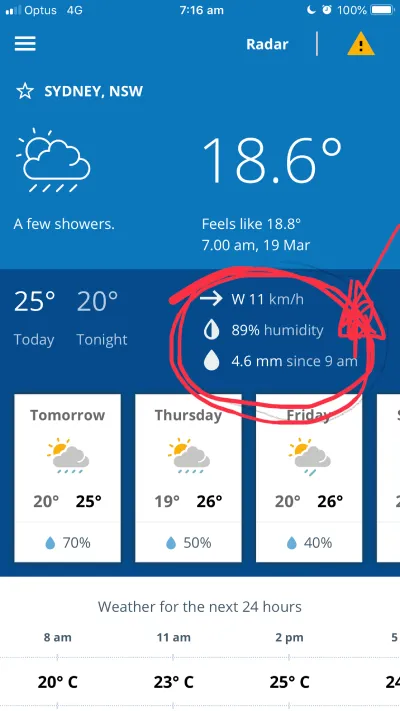 89% RH in Sydney after rain. At the same time, Brisbane 94%, Melbourne 92%, Adelaide 87%
Recommended Products from Bilby 3D
- Hygrometer – Independant Temperature and Humidity Readout
- Silicon Pack – Desiccant satchets
- Polymaker Polybox – Sealed Feed-through, refreshable dessicant pouches and hygrometer
- Polymaker PolyDryer – Heated Drying Box with saleable swappable filament boxes
- Raise3D 2.5 kg Filament Box - Takes a range of large and small spools with switchable rollers for different configurations. Passive drying, with hygrometer in lid
- Creality SpacePi - 4 x 1kg Spool Feeding Box with programmable presets for the heating cycle of different materials
- Wonderful 23L Dry Cabinet - Small cabinet with active drying (molecular seive) without heat. Setable via knob.
- Wonderful 388L Dual-Door Cabinet - Larger cabinet capable of reducing humidity down to 1%, with digital control and readout.
- Mingda Auto Dry & Feed Cabinet - Drys filament without heating and automatically switches between 3 spools per extruder. Only for the Mingda MD-600D, 1000D and Raptor series
- Full Drying Product Range
Summary
- Store filament in RH-controlled environments - Prevention is the best cure
- Monitor RH, not just temperature
- Consider drying before printing—especially PA, TPU, CF filaments
- Avoid over-drying sensitive materials like PLA
- Choose professional-grade solutions with RH control
Shop Now
More Articles
